
A railroad town that went from 1,696 people to 150,108
Concrete Contractors in Mesquite, TX
Driveways, patios, pool decks and slab repair for a city built mostly after World War II.
- Estimate visit that checks the base, slope and old slab, at no charge
- Line-by-line price in writing, agreed before demolition day
- City permit question answered for your address ahead of scheduling
Concrete Work in Our Home City
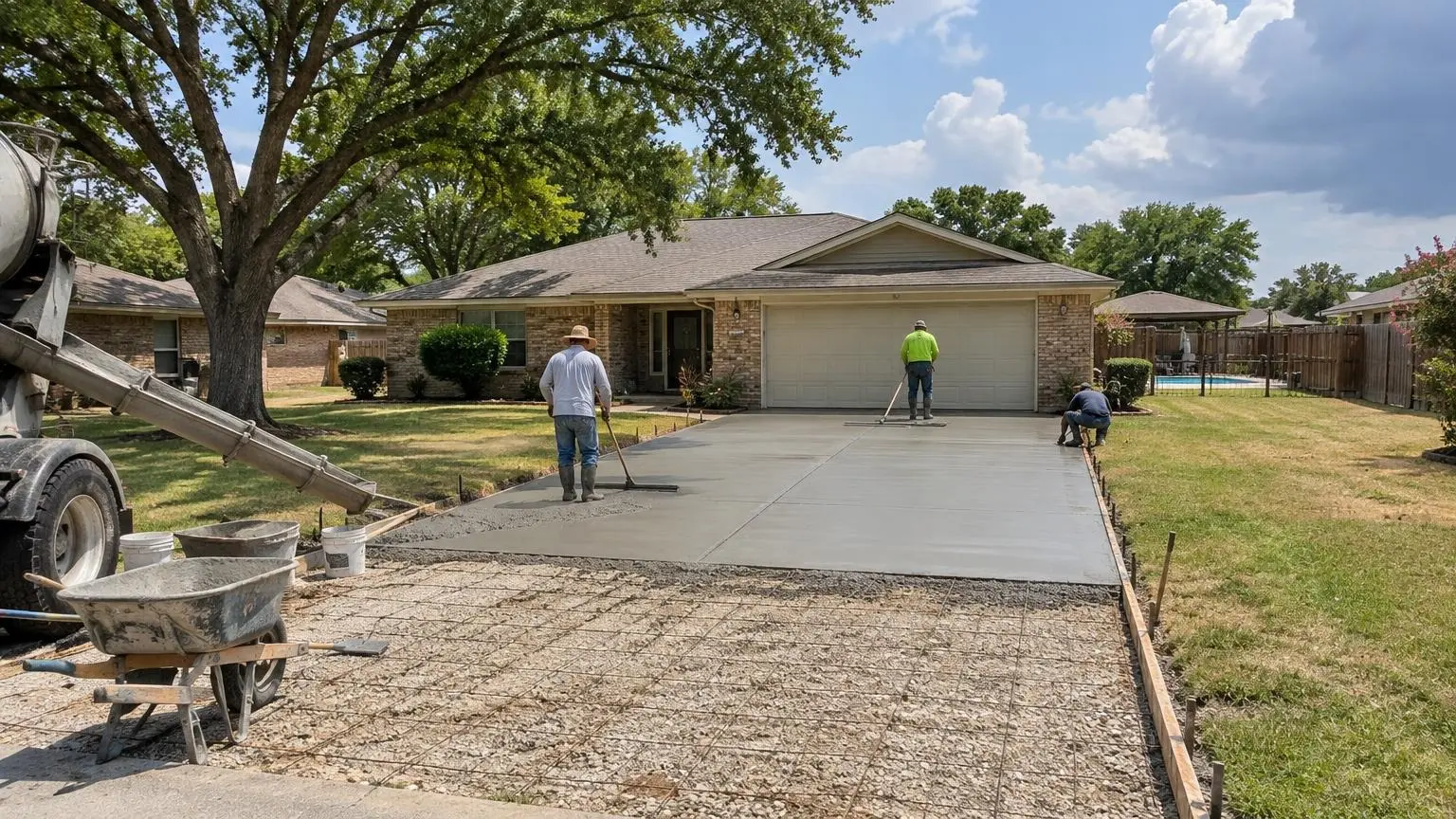
Mesquite is home base, and as concrete contractors here we keep running into the same few problems: driveways that have cracked and settled, patios that tilt back toward the house, and pool decks that have lifted at the edges. The city covers about 49 square miles east of Dallas, and almost all of it was built out in a few busy decades. That history explains a lot about the concrete you see in Mesquite driveways today.
How fast Mesquite grew
Mesquite was founded in 1873 on land along the Texas and Pacific Railway line between Dallas and Shreveport, and it took its name from Mesquite Creek. It incorporated on December 3, 1887. For a long time it stayed small. In 1950 the census counted 1,696 people. By 1960 that number was 27,526, and by 1970 it was 55,131. The city passed 100,000 residents by 1990 and counted 150,108 in 2020.
That curve matters for concrete. A city that grows that quickly pours most of its driveways, sidewalks and garage slabs within a few decades. Many of those slabs are now forty, fifty or sixty years old. Old flatwork does not fail all at once. It cracks at the weakest joint, a panel sinks a little, water gets under it, and the problem spreads. When we look at an older Mesquite driveway, the first question is whether the panels can be repaired or whether the base underneath has washed out enough that replacement is the honest answer.
The ground under your slab
Mesquite sits in the Blackland Prairie, a belt of dark, alkaline clay that runs through the Dallas–Fort Worth area. That clay shrinks and swells as its moisture changes. In a dry summer it pulls away and cracks deeply. After a wet spring it swells again. A slab sitting on top of that soil gets pushed and dropped over and over.
We plan for that in a few practical ways:
- Base preparation. We remove soft material, bring in select fill or crushed base where it helps, and compact it before any concrete arrives.
- Steel, not just mesh. For driveways and slabs we set rebar on chairs so it sits in the middle of the concrete, where it can hold cracks tight.
- Joints in the right places. Control joints give the slab a planned place to crack. We space them to the thickness of the pour and cut or tool them to the right depth.
- Drainage. Every patio and driveway is sloped away from the house so water does not sit at the foundation or soak the clay under the slab.
Heat, storms and timing
Wikipedia lists Mesquite's record high at 112°F, set in 1980, and its record low at 1°F, set in 1989. May is usually the wettest month. In practice that means we pour early in the day in summer, keep fresh concrete wet or covered while it cures, and watch the forecast closely in spring, when a heavy storm can wash out a fresh finish. In the rare hard freeze we protect new work and do not pour on frozen ground.
Six kinds of work, one city
Concrete driveways. Replacing a cracked, sunken driveway is the most common call. We break out the old panels, fix the base and pour new concrete with steel and proper joints. If only one or two panels are bad, we tell you whether a partial replacement makes sense.
Concrete patios. Many older homes have a small covered slab off the back door. Extending it is a popular project. We tie the new pour to the old slab with dowels where it is sound, or pour a separate slab with an isolation joint where it is not.
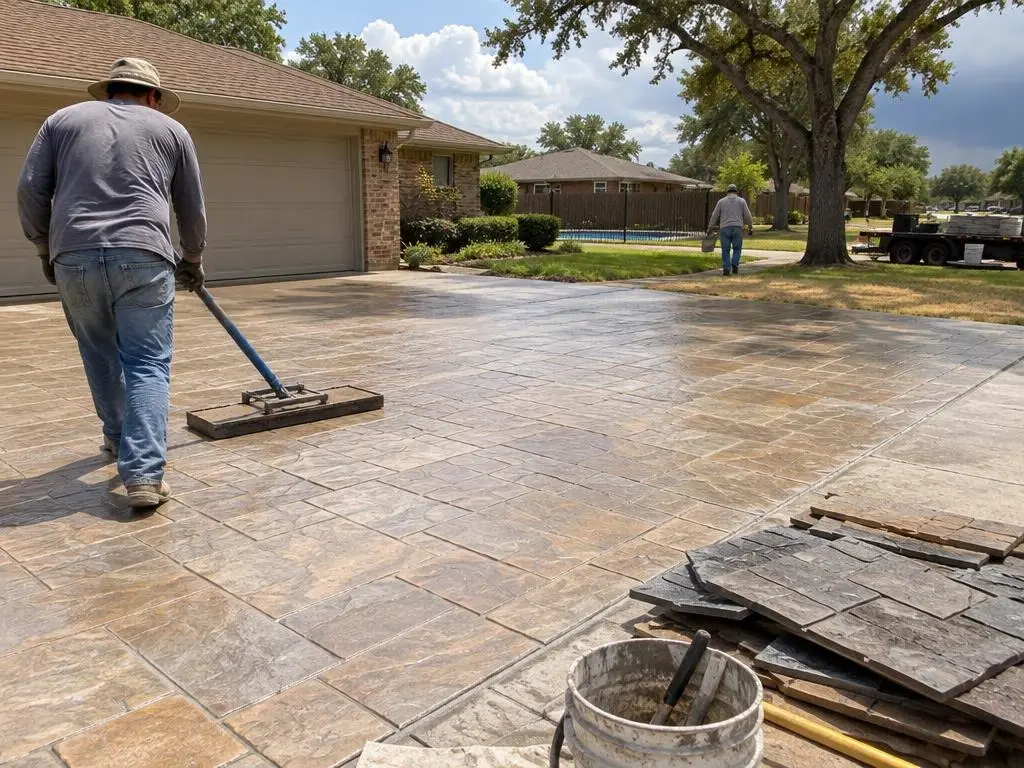
Stamped concrete. For a patio or walkway that looks like stone or brick, we stamp and color the concrete while it is fresh, then seal it. Stamped surfaces need resealing every few years to keep the color and protect the surface.
Pool decks. Pool decks here take sun, splash water and pool chemicals. We use a textured finish that grips when wet and build in expansion joints at the coping.
Concrete slabs. Shed pads, workshop floors, carports and garage slabs all start with a level, compacted base and the right thickness for the load.
Concrete repair. Not every crack needs a new slab. Some can be sealed, some panels can be lifted, and some edges can be patched. We show you which is which.
Neighborhoods, malls and freeway years
Wikipedia lists 33 named neighborhoods in Mesquite, from Casa View Heights and Big Town Estates near the Dallas line to Samuell Farms, Broadmoor Estates, Rollingwood Hills and Creek Crossing. Their ages follow the city's landmarks. Big Town Mall opened in 1959, Interstate 635 reached Mesquite in 1970 and Town East Mall opened in 1971, and subdivisions filled in around each one. When we price a Mesquite driveway, the age of the street is one of the first things we note, because it hints at how long the original slab has been riding on the clay and how much base may be left under it.
Permit rules here run through the city's Building Inspection division, and its online portal asks homeowners and contractors alike to register before applying. We confirm what your job needs before it goes on the calendar.
What Shapes Concrete Work in Mesquite
- Railroad founding. Founded in 1873 along the Texas and Pacific Railway and incorporated on December 3, 1887; named for Mesquite Creek.
- Postwar growth. Population rose from 1,696 in 1950 to 27,526 in 1960, passed 100,000 by 1990 and reached 150,108 in the 2020 census.
- Clay soil. The Dallas area lies in the Blackland Prairie, whose dark clay shrinks and swells with moisture and cracks deeply in dry weather.
- Temperature extremes. Recorded highs reach 112°F (1980) and lows 1°F (1989), with May usually the wettest month of the year.
Our Services in Mesquite, TX
Mesquite Questions
My Mesquite house dates from the 1970s. Is the original driveway worth saving?
The base decides it. Panels that are cracked but still level can often be sealed and spot-repaired for years more. Panels that have sunk, tipped, or have water running beneath them usually mean the base is gone, and replacement is the better spend. We look before recommending either.
Why does concrete crack so much in Mesquite?
The clay under most of the city shrinks when dry and swells when wet, which moves slabs. Good base prep, rebar and well-placed control joints keep that movement from turning into wide, uneven cracks.
Does a new driveway in Mesquite need a permit?
Some concrete work does and some does not. The City of Mesquite handles permits through its Building Inspection division and publishes residential concrete standards, so we confirm the current rules for your job before the pour is scheduled.
Free Estimates in Mesquite, TX
Free on-site estimates anywhere in Mesquite.
Concrete Contractors Near Mesquite
- Concrete Contractors in Garland, TX
- Concrete Contractors in Balch Springs, TX
- Concrete Contractors in Sunnyvale, TX
- Concrete Contractors in Forney, TX
- Concrete Contractors in Rowlett, TX
- Concrete Contractors in Seagoville, TX
- Concrete Contractors in Rockwall, TX
- Concrete Contractors in Heath, TX
- Concrete Contractors in Sachse, TX
- Concrete Contractors in Wylie, TX
- Concrete Contractors in Murphy, TX
- Concrete Contractors in Richardson, TX
- Concrete Contractors in Royse City, TX
- Concrete Contractors in Fate, TX
- Concrete Contractors in Terrell, TX
- Concrete Contractors in Crandall, TX
- Concrete Contractors in Kaufman, TX
- Concrete Contractors in Lancaster, TX
- Concrete Contractors in Hutchins, TX
- Concrete Contractors in McLendon-Chisholm, TX
- Concrete Contractors in Heartland, TX